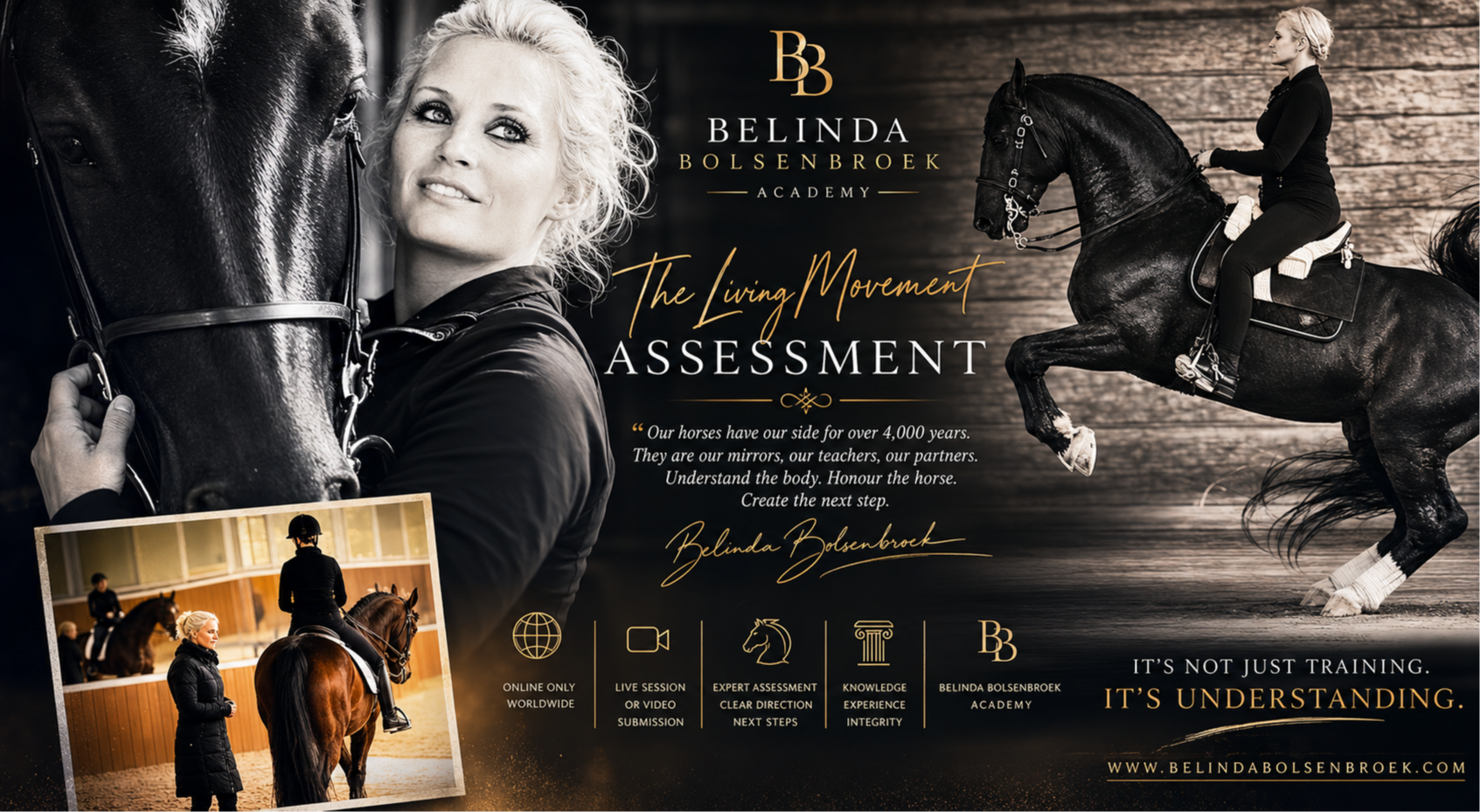
Your horse has been Telling you something. The Question is what.
A diagnosis gives you a name for what went wrong. It rarely tells you why, or what to do next that will actually change the picture. Kissing spine, sacroiliac dysfunction, a compromised suspensory system, unexplained resistance, horse that has quietly stopped working he way he used to - These are to endpoints. They are reports rom a body hat has been compensating for anger then anyone noticed.
The Living Movement Assessment is where we find out what the body is actually saying.
I work from the principles of the Belinda Bolsenbroek Knowledge System - an integrated framework drawing on peer-reviewed equine biomechanics, neuromotor science, and more than 2 decates of clinical rehabillitaton work wit horses across every discipline and background. What I am Looking for is not the diagnosis. I am looking for what produced it: The movement patterns, the compensation chains, the saddle fit, the posture, the history written in the horse's body before it arrived at the point where you sought help.
From that reading, I give you a clear picture of what I see and a direction for what comes next."
How it works
"You have two options for the assessment itself.
Option 1 — Live session: Meet me live with your horse via a Pivo or Pixem camera in your arena or yard. I watch the horse m“ove, observe the body at rest and in motion, and we talk through what I’m seeing in real time.
Option 2 — Video + Zoom debrief: Send me a ten minute video of your horse — walking and trotting in hand, ideally from both sides and from behind — along with a written account of the history: what you’ve noticed, when it started, what’s been tried, what the vets and therapists have found. We then meet on Zoom and I walk you through my findings in full.
Either way, please bring any diagnostics you have — X-rays, vet reports, bodywork notes. The more of the picture I can see, the more useful I can be.”
AUD $349
US $ 249
"If you choos to continue into a full rehabilitation pathway after your assessment, this amount is deducted from your pathway investment"
“The horse that cannot be ridden is not necessarily the horse that will never be ridden. The horse that has been labelled difficult, or resistant, or unsound without clear cause — that horse is usually a horse whose body has run out of workarounds and needs someone to hear what it has been saying.
Neuromotor movement therapy, applied correctly and in the right sequence, restores what poor loading, ill-fitting equipment, and compensatory movement have taken from the system. The exercises are simple. The progression is incremental. The results, when the work addresses the living system rather than the individual diagnosis, are often faster than owners expect.
I work with students entirely online. Location is not a limitation.”